Java多線程編程概述
Java多線程的安全問題
Java多線程同步
- Java多線程同步機(jī)制簡介
- Java多線程鎖
- Java多線程同步代碼塊Synchronized
- Java多線程同步方法
- Java多線程臟讀
- Java多線程出現(xiàn)異常會(huì)自動(dòng)釋放鎖
- Java多線程死鎖
- Java volatile關(guān)鍵字的作用
- Java多線程之volatile非原子性
- Java原子類自增自減操作
- Java CAS多線程
- Java原子變量
Java多線程間的通信
- Java線程間的通信方式
- Java多線程的等待通知機(jī)制
- Java生產(chǎn)者消費(fèi)者模式
- Java中利用管道實(shí)現(xiàn)線程間的通訊
- Java線程中join方法
- Java ThreadLocal使用
Java線程Lock
- Java中鎖的可重入性
- Java ReentrantLock使用
- ReentrantLock可重入性
- Java多線程:lockInterruptibly()方法
- Java多線程:tryLock()方法
- Java多線程:newCondition()方法
- Java公平鎖與非公平鎖
- Lock鎖的常用方法
- Java多線程讀寫鎖
Java多線程管理
- Java線程組
- Java多線程捕獲異常處理
- Hook鉤子線程注入
- Java線程池是什么
- 多線程JDK線程池
- Java線程池的底層實(shí)現(xiàn)
- Java線程池的拒絕策略
- Java線程池ThreadFactory
- Java監(jiān)控線程池
- Java線程池?cái)U(kuò)展
- Java線程池的大小與線程池死鎖
- Java線程池異常處理
- Java ForkJoinPool線程池
保障線程安全的設(shè)計(jì)技術(shù)
Java鎖的優(yōu)化及注意事項(xiàng)
Java多線程集合
【Java多線程】單例模式與多線程
多線程JDK線程池

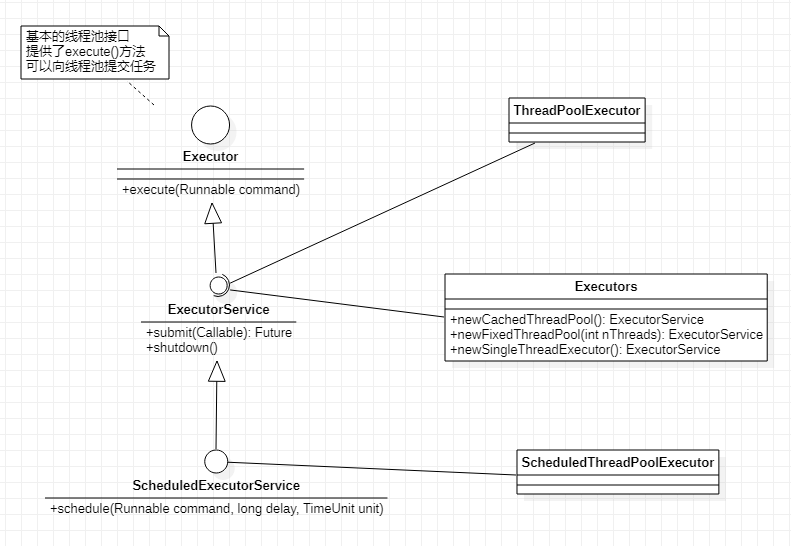
JDK提供了一套Executor框架,可以幫助開發(fā)人員有效的使用線程池。
package com.wkcto.threadpool;

import java.util.concurrent.ExecutorService;
import java.util.concurrent.Executors;

/**
 * 線程池的基本使用
 */
public class Test01 {
    public static void main(String[] args) {
        //創(chuàng)建有5個(gè)線程大小的線程池,
        ExecutorService fixedThreadPool = Executors.newFixedThreadPool(5);

        //向線程池中提交18個(gè)任務(wù),這18個(gè)任務(wù)存儲(chǔ)到線程池的阻塞隊(duì)列中, 線程池中這5個(gè)線程就從阻塞隊(duì)列中取任務(wù)執(zhí)行
        for (int i = 0; i < 18; i++) {
            fixedThreadPool.execute(new Runnable() {
                @Override
                public void run() {
                    System.out.println(Thread.currentThread().getId() + " 編號(hào)的任務(wù)在執(zhí)行任務(wù),開始時(shí)間: " + System.currentTimeMillis());
                    try {
                        Thread.sleep(3000);     //模擬任務(wù)執(zhí)行時(shí)長
                    } catch (InterruptedException e) {
                        e.printStackTrace();
                    }
                }
            });
        }

    }
}
package com.wkcto.threadpool;

import java.util.concurrent.Executors;
import java.util.concurrent.ScheduledExecutorService;
import java.util.concurrent.TimeUnit;

/**
 * 線程池的計(jì)劃任務(wù)
 */
public class Test02 {
    public static void main(String[] args) {
        //創(chuàng)建一個(gè)有調(diào)度功能的線程池
        ScheduledExecutorService scheduledExecutorService = Executors.newScheduledThreadPool(10);

        //在延遲2秒后執(zhí)行任務(wù), schedule(  Runnable任務(wù), 延遲時(shí)長, 時(shí)間單位)
        scheduledExecutorService.schedule(new Runnable() {
            @Override
            public void run() {
                System.out.println(Thread.currentThread().getId() + " -- " + System.currentTimeMillis() );
            }
        }, 2, TimeUnit.SECONDS);

        //以固定的頻率執(zhí)行任務(wù),開啟任務(wù)的時(shí)間是固定的, 在3秒后執(zhí)行任務(wù),以后每隔5秒重新執(zhí)行一次
/*        scheduledExecutorService.scheduleAtFixedRate(new Runnable() {
            @Override
            public void run() {
                System.out.println(Thread.currentThread().getId() + "----在固定頻率開啟任務(wù)---" + System.currentTimeMillis());
                try {
                    TimeUnit.SECONDS.sleep(3);  //睡眠模擬任務(wù)執(zhí)行時(shí)間 ,如果任務(wù)執(zhí)行時(shí)長超過了時(shí)間間隔,則任務(wù)完成后立即開啟下個(gè)任務(wù)
                } catch (InterruptedException e) {
                    e.printStackTrace();
                }
            }
        }, 3, 2, TimeUnit.SECONDS);*/

//在上次任務(wù)結(jié)束后,在固定延遲后再次執(zhí)行該任務(wù),不管執(zhí)行任務(wù)耗時(shí)多長,總是在任務(wù)結(jié)束后的2秒再次開啟新的任務(wù)
        scheduledExecutorService.scheduleWithFixedDelay(new Runnable() {
            @Override
            public void run() {
                System.out.println(Thread.currentThread().getId() + "----在固定頻率開啟任務(wù)---" + System.currentTimeMillis());
                try {
                    TimeUnit.SECONDS.sleep(3);  //睡眠模擬任務(wù)執(zhí)行時(shí)間 ,如果任務(wù)執(zhí)行時(shí)長超過了時(shí)間間隔,則任務(wù)完成后立即開啟下個(gè)任務(wù)
                } catch (InterruptedException e) {
                    e.printStackTrace();
                }
            }
        }, 3, 2, TimeUnit.SECONDS);

    }
}